News Story
"Nature-Made" Computers
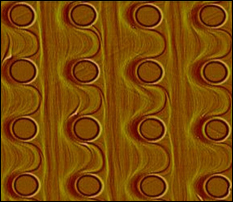
Template self-organization--cylindrical pits on a silicon surface.
View a computer simulation of template formation.
40MB Quicktime video will open in a new window. Movie will take a few moments to load.
At the Clark School, Ray Phaneuf, associate professor of materials science and engineering, has developed a template nature can follow to produce "self-assembling" structures. The template causes atoms to be arranged in a defined pattern that can serve a variety of purposes—a semiconductor in a laptop, a component in a cell phone or a sensor in a wearable device.
The idea of self-assembly in nature has long been known—crystallization is one such process; the formation of shells into spirals is another. However, researchers have been limited to the designs that nature already knows how to make. Phaneuf's work introduces a man-made template that nature then follows, addressing a number of manufacturing difficulties.
"While we understand how to make working nanoscale devices, making things out of a countable number of atoms takes a long time," Phaneuf said. "Industry needs to be able to mass-produce them on a practical time scale."
The template process can be used by device manufacturers to mass-produce tiny components rapidly and efficiently, reduce costs, shrink device sizes, and improve devices' functionality in ways previously not possible.
"The same template can be used thousands of times," Phaneuf said. "This results in enormous savings."
Phaneuf says his work is one step in a "cocktail" approach to computer assembly—an engineer's dream in which one could "mix-up" a computer the same way one mixes a drink.
"Imagine you shake up a cocktail and spill it onto a table," Phaneuf said. "The liquid will collect in pools in a manner designated by nature.
"Now imagine that first you coated the table with wax and scraped a pattern into it. Now when you spill the liquid onto the table, it collects in the pattern you scraped into the wax—it assumes the form you want it to take. When we apply this idea to manufacturing nanoscale computer components, collections of atoms become ordered, accessible, controllable and reproducible—characteristics crucial to their use in high-tech devices."
These devices could include those used in the growing field of quantum computing, which is believed to hold promise for carrying out exceptionally difficult mathematical processes, Phaneuf said. An application of the templates might be self-assembly of coupled quantum dots to form "qubits," the building blocks of quantum computers. According to Phaneuf, templating could be used to make the manufacture of this highly complicated system more feasible: "Addressing individual qubits might be done optically, to get around the problem of trying to wire them all up."
Phaneuf's work focuses on silicon and gallium arsenide components. Silicon is the prevalent material for components in computers while gallium arsenide is used more often in cell phones.
The templates are created using photolithography (a process akin to photography, in which the template is chemically developed after being exposed to light) and etching, or by "nanoscraping," in which an atomic force microscope is used to selectively scrape the pattern into the template.
View the related press release online.
More Information:
"Templating for Directed Self Assembly"
Ray Phaneuf's Research Group:
http://www.glue.umd.edu/~phaneuf/Welcome.html
Published October 30, 2007
Recent Stories
Stories / Apr 26, 2024
Engineering Students Fabricate Tomorrow’s Solutions Today

Stories / Apr 25, 2024
Alum Returns to Fire Protection Engineering as New Online...

Stories / Apr 25, 2024
Erika Moore Named a 2024 TED Fellow

Stories / Apr 25, 2024
ECE Ph.D. Student Wins UMD 3MT Competition

Stories / Apr 25, 2024
UMD Team Advances in NIST UAS 5.0 Competition, Wins Three Best...
Stories / Apr 23, 2024
In Soft Robotics, Instability Can Be a Plus

Stories / Apr 22, 2024
When Vision Fails, a Suit Could Steer Pilots to Safety
Stories / Apr 19, 2024
JC Zhao Named Dean of University of Connecticut College of...
Stories / Apr 19, 2024
Celebrating Asian, Pacific Islander, and Desi American Engineers

Stories / Apr 17, 2024
Four BIOE Terps Awarded NSF Graduate Research Fellowships