|
Engineers: California Flood Risks are "Disaster Waiting to Happen" |

|
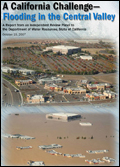
FOR IMMEDIATE RELEASE CONTACT: Lee Tune Missy Corley COLLEGE PARK, Md.—While flooding in California's Central Valley is "the next big disaster waiting to happen," water-related infrastructure issues confront almost every community across the country, according to engineers at the University of Maryland's Clark School of Engineering in separate reports to California officials and in the magazine Science. An independent review panel chaired by Clark School Research Professor of Civil Engineering Gerald E. Galloway said the area between the Sacramento and San Joaquin river floodplains faces significant risk of floods that could lead to extensive loss of life and billions of dollars in damages. The panel's report, "A California Challenge: Flooding in the Central Valley," was commissioned by California's Department of Water Resources. The panel pointed out that many of the area's levees, constructed over the past 150 years to protect communities and property in the Central Valley, were poorly built or placed on inadequate foundations. Climate change may increase the likelihood of floods and their resulting destruction. The panel recommends that state and local officials take swift action to reduce the risk to people and the environment. The comprehensive flood-risk abatement strategy the panel recommends focuses on land-use planning and integration with other basin water management activities. "The challenges that California faces are widespread across the nation," Galloway said. "The recent failure of a levee in a Nevada irrigation canal points out growing infrastructure problems." Another civil engineering researcher from the Clark School, Dr. Lewis "Ed" Link, also served on the California panel. "I believe the State of California is taking a very enlightened approach to difficult issues," Link said. "Supporting this study is a good example, as is their examination of risk for the entire Central Valley. They are looking strategically at measures that can create long-term solutions, a model for others to follow." Galloway is also co-author of an article in tomorrow's Science – "Aging Infrastructure and Ecosystem Restoration" – which calls for the targeted decommissioning of deteriorated and obsolete infrastructure in order to support the restoration of degraded ecosystems. "As we move forward with infrastructure enhancement, we must consider how, in the process of carrying out these activities, we can restore and enhance the natural and beneficial functions of the floodplain, which can at the same time reduce flood losses," Galloway said. Link and Galloway were prominent figures in the review of the levee system around New Orleans after Hurricane Katrina devastated the area. Link served as director of the federal government's Interagency Performance Evaluation Task Force, which evaluated the hurricane protection system around New Orleans. Galloway is a former brigadier general with the Army Corps of Engineers and has been part of the State of Louisiana review team looking at long-term plans for restoration of the Gulf Coast. CONTACT INFORMATION: Gerald E. Galloway Lewis "Ed" Link More Information: Science article—"Aging Infrastructure and Ecosystem Restoration" About the A. James Clark School of Engineering The Clark School's graduate programs are collectively the fastest rising in the nation. In U.S. News & World Report's annual rating of graduate programs, the school is 16th among public and private programs nationally, 10th among public programs nationally and first among public programs in the mid-Atlantic region. The School offers 13 graduate programs and 12 undergraduate programs, including degree and certification programs tailored for working professionals. The school is home to one of the most vibrant research programs in the country. With major emphasis in key areas such as communications and networking, nanotechnology, bioengineering, reliability engineering, project management, intelligent transportation systems and space robotics, as well as electronic packaging and smart small systems and materials, the Clark School is leading the way toward the next generations of engineering advances. Visit the Clark School homepage at www.eng.umd.edu.
|
|

|
||||||
 |
|||||||||